
Many parents are surprised when their child’s school does not regularly send homework home. While homework practices vary by school, grade, and teacher, families may still want a structured way to reinforce what a child is learning during the school day. The good news is that parents do not have to recreate the curriculum on their own. With the right information and careful review, artificial intelligence (AI) can help turn a course outline, syllabus, unit goal, or teacher-provided learning objective into customized practice materials for home.
Why Reinforcement Matters
Home practice gives children another opportunity to work with concepts they have already encountered in class. The purpose is not to replace the teacher or add hours of extra work. It reinforces learning, builds confidence, identifies areas that may need more attention, and helps parents understand what their child is being asked to master.
- Revisit concepts introduced in class while they are still fresh.
- Build fluency and confidence through short, focused practice.
- Give parents a clearer view of what their child understands and where they may need support.
- Create consistent study habits without turning home into a second school day.
When the School Doesn’t Send Homework
If your child is not bringing home traditional homework, start by gathering the information the school has already provided. Look for a course outline, syllabus, unit overview, pacing guide, teacher newsletter, learning platform, textbook chapter, or list of standards and objectives. These materials tell you what the class is actually covering. That is the information you want to give the AI tool.
Lean Into AI – But Give It the Curriculum
The most useful way to use AI is not to ask for random grade-level work. Instead, give the tool the same academic target your child is working on at school. For example, if the unit goal says students are learning fraction equivalence and comparison using denominators 2, 3, 4, 5, 6, 8, 10, 12, and 100, include that exact information in your request.
SAMPLE AI PROMPT
“My child is in 4th grade. The current math unit is Fraction Equivalence and Comparison. Students are generating and reasoning about equivalent fractions and comparing and ordering fractions with denominators 2, 3, 4, 5, 6, 8, 10, 12, and 100. Create a colorful, printable worksheet with
10 age-appropriate practice questions. Include visual fraction models such as circles, fraction bars,
and a 100-grid. Mix equivalent-fraction questions, comparisons, ordering, and one or two word problems.
Put the answer key on a separate page.”
How Parents Can Use AI for At-Home Practice
1. Gather the source material. Use the syllabus, unit goal, teacher notes, standards, or other school-provided information.
2. Tell AI the grade and subject. Be specific about the child’s grade level and the exact concept being taught.
3. Paste in the learning objective. The closer the prompt follows the school’s actual unit, the more relevant the practice can be.
4. Ask for the format your child needs. Request color, pictures, fraction bars, number lines, word problems, multiple-choice, or short-answer questions as appropriate.
5. Keep the practice manageable. Ten focused questions can be more useful than an overwhelming packet.
6. Review before your child begins. Check every question, answer choice, diagram, and answer key.
AI can make mistakes – including mathematical and visual errors.
7. Use results as information. Notice patterns. If your child repeatedly struggles with the same concept, bring that information to the teacher rather than asking AI to replace instruction.
Example: An AI-Assisted Fraction Practice Sheet
Below is a draft example of the kind of practice sheet a parent could request after providing the unit objective. The visual models help children connect the symbols in a fraction to parts of a whole.
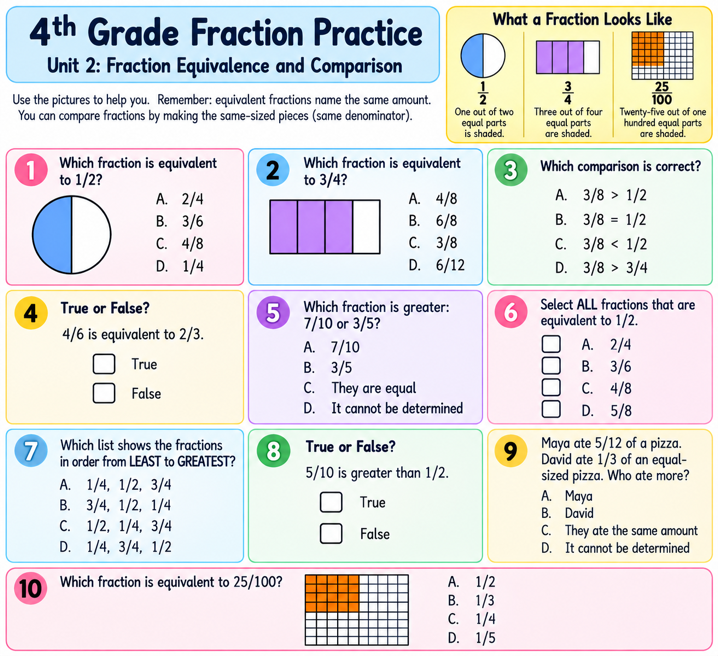
Draft example for illustration. Parents should verify AI-generated educational content before use.
AI Is a Support Tool – Not the Teacher
AI can be an excellent assistant for creating extra practice, but it should not replace the classroom teacher, school curriculum, or professional educational judgment. Parents should use AI to support what is already being taught, not to move a child into unrelated material or assume that an AI-generated explanation is automatically correct.
If the practice reveals a persistent gap, the next step should be communication with the teacher. Ask what strategies are being used in class, whether additional resources are available, and what kind of practice would be most helpful at home.
The Goal: Partnership, Not More Pressure
At-home practice does not have to mean hours of homework. A short, targeted worksheet, a few math problems, ten minutes of reading, or a quick review of vocabulary can reinforce classroom learning without overwhelming a child or family.
When schools provide little or no homework, parents can still be active partners in education. Start with what the school is teaching. Use AI to help turn those learning goals into manageable practice. Review the materials carefully. Then use what you observe to strengthen the conversation between home and school.
Parent Takeaway: You do not need to be a curriculum designer to support learning at home. Start with the school’s learning objectives, use AI thoughtfully to create practice, verify the content, and keep the teacher in the loop when your child needs additional support.